A bearing grease calculator that returns the relubrication interval, grease quantity and NLGI and viscosity grades, cross-checked against SKF's own LubeSelect tool.
- Area
- Sales Engineering
- Status
- In Development
- Replaces
- Guesswork, or sending customers to a competitor's selector tool
- Built for
- Lubricant makers and distributors advising on bearing greases
The problem
Recommending the right grease and relubrication interval for a customer's bearing setup usually meant one of two things: guesswork by whoever was on the call, or sending the customer to a competitor's own technical tool — handing over a sales opportunity along with the technical question.
Neither is good for business. Guesswork risks recommending the wrong product for the operating conditions. Sending customers elsewhere means losing them at exactly the moment they're engaged enough to ask a technical question.
What was built
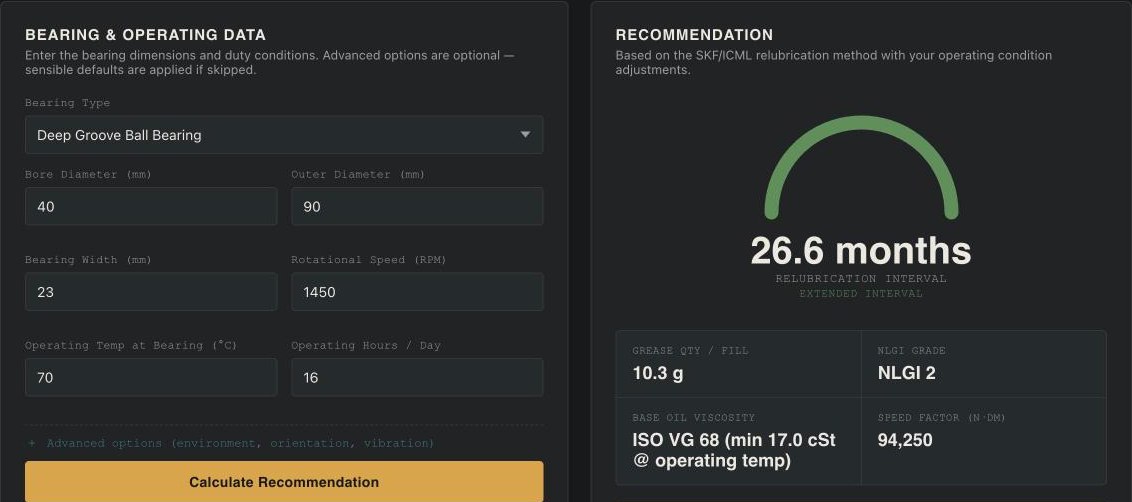
A bearing grease calculator: enter bearing type, size, speed, temperature, and operating conditions, and get back the relubrication interval, grease quantity, viscosity/NLGI grade, and a matched product from the range — all in one pass, without needing a lubrication engineer on the call. The calculation engine is built and validated; deployment and loading the live product catalogue are the remaining steps, so the tool is in development. It is already in internal use by Lukeron's sales team ahead of a public launch.
Validation
This wasn't shipped on faith. It was cross-checked against SKF's own LubeSelect tool in four test cases covering ball, cylindrical roller and spherical roller bearings, landing at roughly 85–88% accuracy for ball bearings. For ball bearings, that's close enough to function as a genuine engineering credibility tool — not a marketing gimmick dressed up as a calculator.
How it was checked
The calculator uses real digitised data from a published SKF relubrication chart, then was checked against SKF's own live LubeSelect tool. Four cross-checks were run:
| Bearing type | Speed | Result vs. SKF's tool |
|---|---|---|
| Ball bearing | 1,450 rpm | Inside SKF's output range — no correction needed |
| Cylindrical roller | 1,450 rpm | About 3× too high — corrected to match |
| Spherical roller | 750 rpm | About 2.4× too low — corrected to match |
| Ball bearing | 3,000 rpm | Inside SKF's output range again |
Ball bearings were confirmed at two speeds, which is where the roughly 85–88% confidence figure comes from. The two roller corrections each rest on a single calibration point, so those results are directional, not lab-grade — and the tool says so on screen, with a prompt to confirm with a lubrication engineer before applying results to critical machinery. That honesty is part of what makes the number credible.
Why this matters
A technical buyer — a plant maintenance engineer, a procurement lead evaluating suppliers — trusts a tool that gets the engineering right more than a sales pitch. Once deployed, this tool does double duty: it's genuinely useful for a customer working out a lubrication schedule, and it's proof, in the moment they're evaluating you, that you understand the technical side of the product you're selling.
If your customers need technical selection help and currently rely on guesswork or a competitor's tool, let's talk about what a fit-for-purpose selector would look like.
Get in touch →